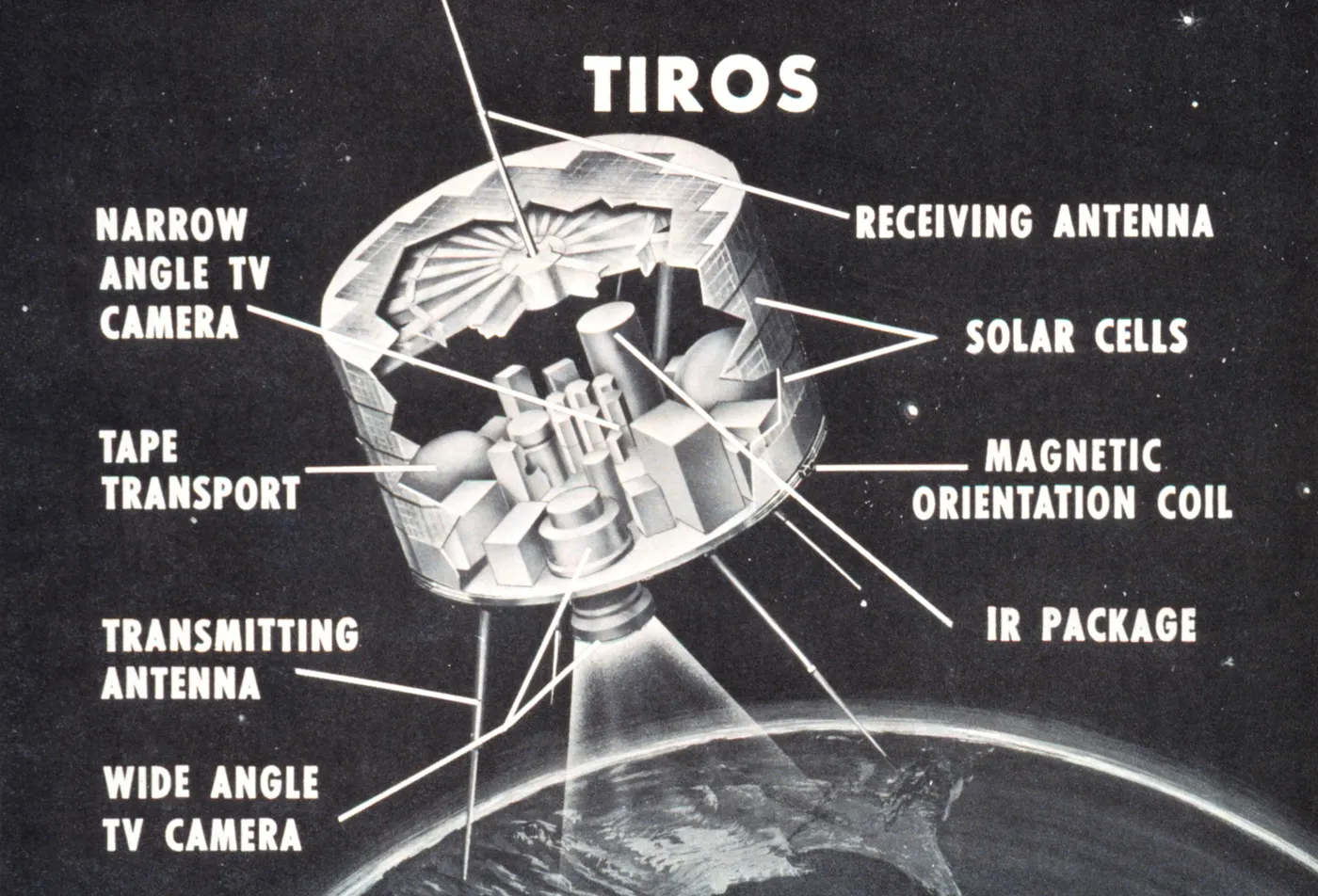

TIROS-7 was the most durable of the series, operating for more than two and a half years — an unusually long life for an early satellite and long enough for its imagery to be used in genuine climatological studies rather than only day-to-day forecasting.
It carried an electron temperature probe alongside its cameras and radiometers, measuring properties of the ionosphere through which it flew. Early weather satellites were frequently used as platforms of convenience for space physics instruments needing a ride.
Its longevity allowed the first satellite-based studies of seasonal change in cloud cover and of the global distribution of cloudiness — quantities that had been estimated from scattered surface observations and turned out to be substantially different when measured from above.
It also continued the radiation budget measurements, extending the record across enough time to begin distinguishing seasonal cycles from noise.
By the time it was retired in 1966 the TIROS programme had moved from proving the concept to routine operation, and its successors were being designed as an operational system rather than as a series of experiments.