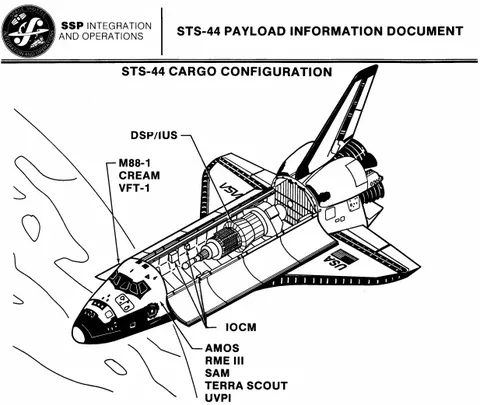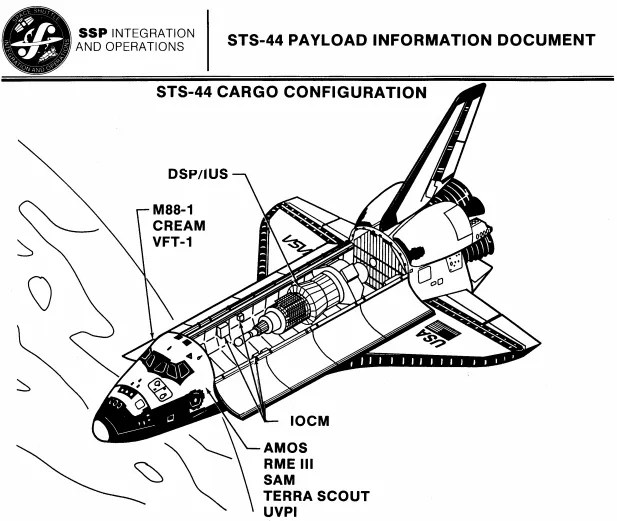


Atlantis flew a Defense Department mission in November 1991, deploying an early-warning satellite designed to watch for missile launches from a high vantage over the globe. The crew of six released the spacecraft and its booster a day into the flight, sending it up to a distant orbit.
The planned ten-day mission was cut to a week when one of the orbiter's navigation units failed, prompting a cautious early return under NASA's post-Challenger conservatism. Even shortened, the flight carried military medical and observation experiments and served as a reminder that the Shuttle still shouldered national-security work — though policy was steadily shifting such payloads onto expendable rockets, a transition that would soon largely free the fleet for science and station-building.
Atlantis launched at night in November 1991 to deploy an early-warning satellite, part of the constellation that watches for the infrared signature of ballistic missile launches. Unusually for a military mission, the payload was acknowledged, and the flight was conducted with only partial security restrictions.

The mission was cut short. One of the orbiter's three inertial measurement units — the gyroscopic platforms that tell the flight computers which way the vehicle is pointing — failed after a few days, and although two remained, the flight rules called for coming home rather than continuing on reduced redundancy. Ten days became six.
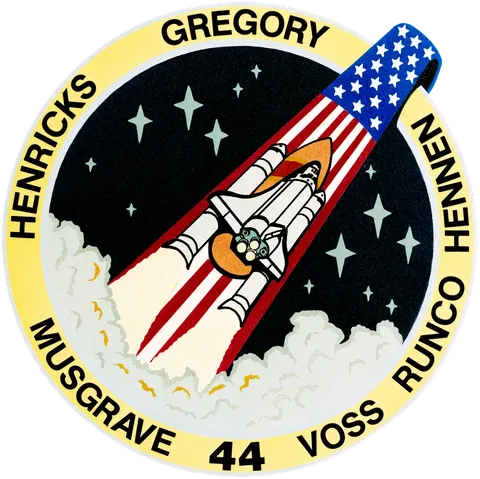
Aboard was Story Musgrave, on his third of six flights, and a crew conducting military-sponsored medical research on how spaceflight affects soldiers' performance — the deconditioning of muscle and bone, the disruption of sleep, the loss of orthostatic tolerance on return. Much of it duplicated civilian life-science work, which is precisely why the duplication was eventually judged not worth a dedicated flight.