
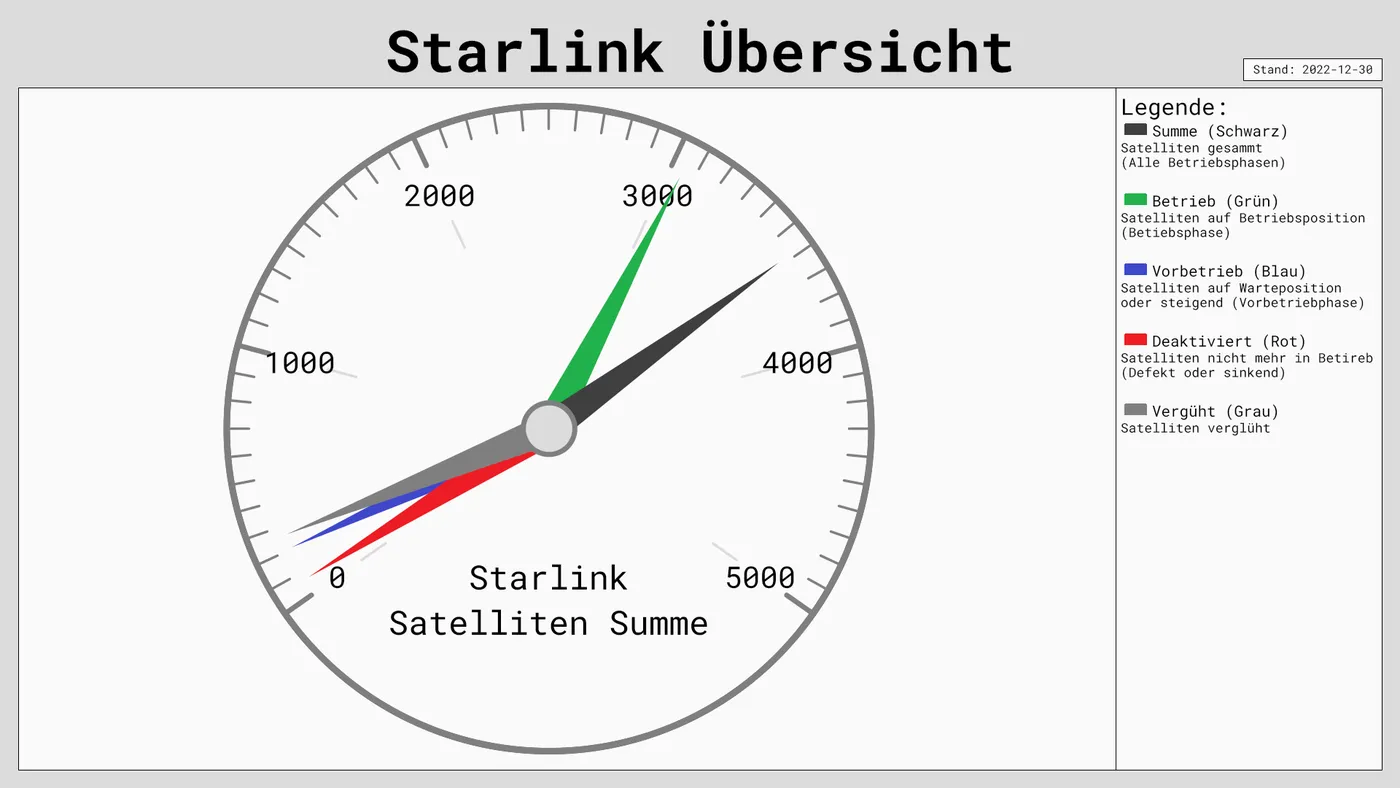

Starlink is the largest constellation of satellites ever built, and by a wide margin. Beginning in 2019 it has grown to several thousand spacecraft in low orbit — more than half of all active satellites — delivering broadband internet by relaying signals between user terminals, the satellites themselves and ground stations.
Its technical premise is that low orbit gives far lower latency than the geostationary satellites traditionally used for internet service, at the cost of needing thousands of spacecraft rather than a handful. That only became economically feasible with mass-produced satellites and a reusable rocket to launch them sixty at a time.

The service has had genuine consequences. It provides connectivity in places where terrestrial infrastructure does not reach, has been used extensively during natural disasters, and became strategically significant in Ukraine — where a private company's control of battlefield communications raised questions about corporate power that remain unresolved.

Astronomers objected from the outset, and with cause. The satellites are bright enough to leave trails across long-exposure images, and radio emissions interfere with sensitive receivers. The company has implemented darkening measures and worked with observatories, which has reduced but not eliminated the impact.
The larger question is orbital sustainability. The satellites are placed low enough to re-enter within a few years if they fail, which is responsible, but the sheer number raises collision-avoidance and debris concerns that the existing regulatory framework was not designed to handle. Several competing constellations are now in development.