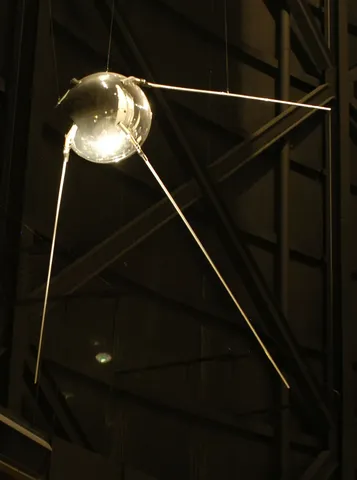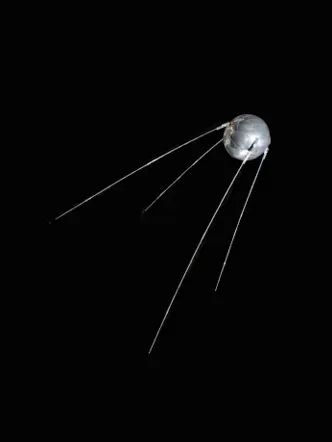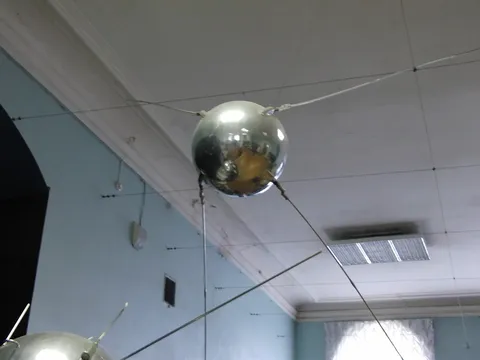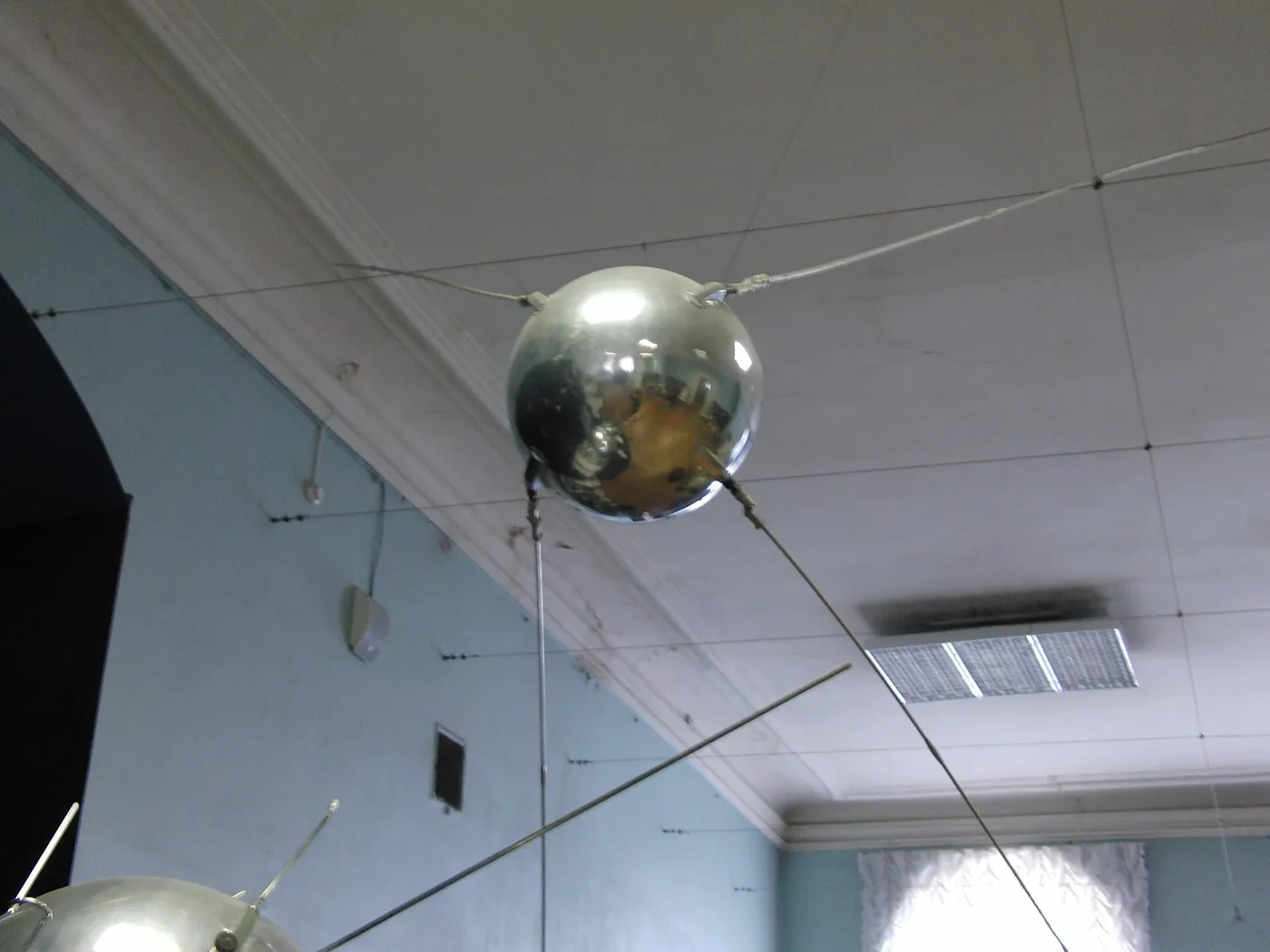
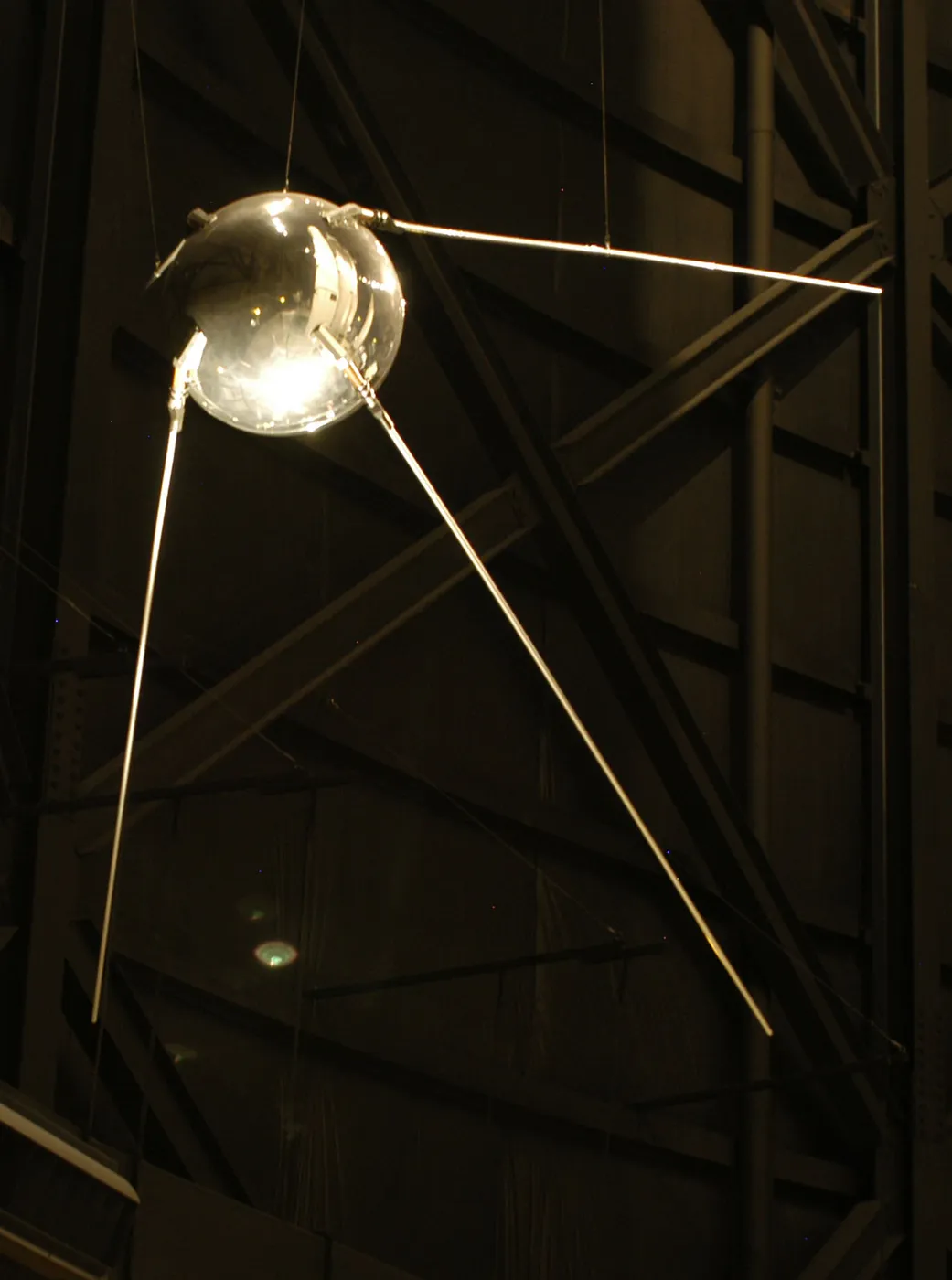

Sputnik 1 began as a fallback. The Soviet Union's flagship scientific satellite — known internally as "Object D" — had fallen badly behind schedule, and chief designer Sergei Korolev, wary that the Americans might launch first, won approval to fly a far simpler craft in its place. The result was PS-1, Prosteyshiy Sputnik or "the simplest satellite": a polished aluminium sphere just 58 cm across, carrying little more than two radio transmitters and a battery. Its overriding objective was to get something — anything — into orbit before the United States.
On 4 October 1957 an R-7 rocket lifted off from the Baikonur Cosmodrome and placed the sphere into an elliptical orbit. Its steady "beep-beep" at 20 and 40 MHz was deliberately tuned so that ordinary shortwave listeners and amateur radio operators around the world could hear it for themselves — turning the satellite into its own proof of flight. Those same signals served the mission's scientific aims: their propagation tested the behaviour of the ionosphere, while the slow decay of the orbit let scientists measure the density of the upper atmosphere, until then largely guesswork. Korolev's team reportedly waited anxiously through the night for confirmation that the satellite had completed a full orbit and was still transmitting.
The reaction abroad was seismic. That a Soviet signal was passing overhead several times a day triggered the so-called "Sputnik crisis" in the United States and helped spur the creation of NASA the following year. Sputnik itself was short-lived: its batteries fell silent after about three weeks, and on 4 January 1958, after roughly 1,440 orbits, it burned up on re-entry. But as a proving ground for orbital mechanics, tracking, and satellite engineering it had already achieved what mattered — the beep was never the point, only what the beep made possible.
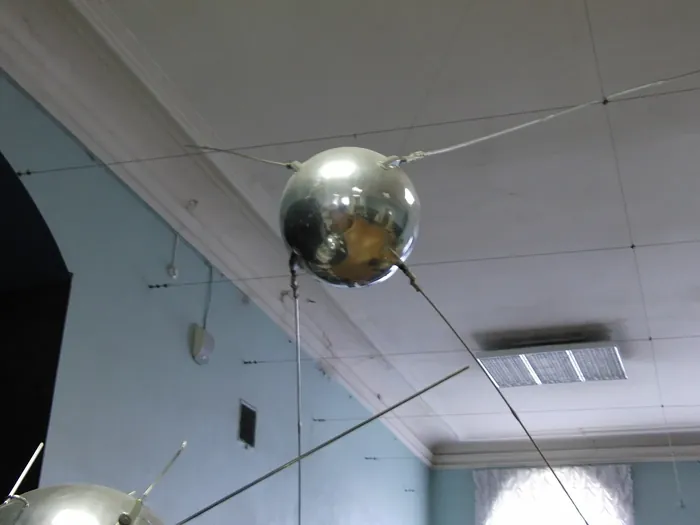
Almost nobody actually saw the satellite. The polished sphere was only 58 centimetres across and far too small to resolve with the naked eye; what crowds around the world queued to watch crossing the dusk sky was the spent core stage of the R-7 rocket, a far larger object trailing it in a similar orbit. The sphere had been polished partly to make it reflective, and it was still invisible.
The man responsible could not be named. Sergei Korolev's identity was a state secret, and he was referred to in Soviet publications only as the Chief Designer; he received no public credit in his lifetime and was identified by name only after his death in 1966. The launch itself came closer to failure than was admitted, with one booster slow to reach full thrust and the orbit ending up lower than intended. The American response, meanwhile, was disproportionate and enormously productive. Within a year Congress had created NASA, established what became DARPA, and passed the National Defense Education Act pouring federal money into science and language teaching. The phrase Sputnik moment entered the language as shorthand for a shock that galvanises a country, and has been invoked by politicians ever since — usually about something less consequential.