
Infrared telescopes have to be cold, because a warm instrument glows in exactly the wavelengths it is trying to observe. Spitzer solved this elegantly by being placed not in Earth orbit but in an orbit around the Sun, drifting slowly behind the planet — away from its heat, where a modest supply of liquid helium could keep the instruments near absolute zero for years.
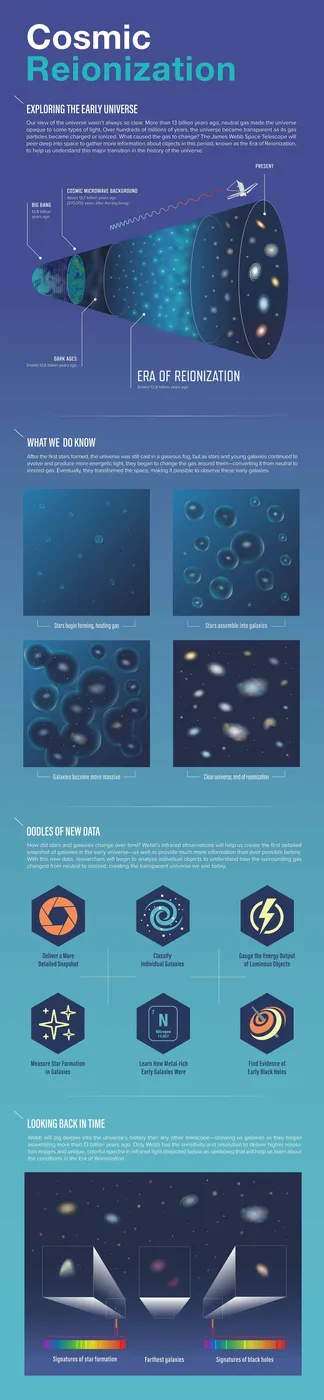
Infrared sees what visible light cannot: the dust-shrouded interiors of star-forming regions, the faint warmth of objects too cool to shine, and the redshifted light of the earliest galaxies. Spitzer produced the first detection of light from a planet orbiting another star — not an image, but the dip in infrared brightness as the planet passed behind its sun.

Its most celebrated result came late. Following up on a ground-based detection, Spitzer stared at a dim red dwarf for three weeks and identified seven roughly Earth-sized planets in the TRAPPIST-1 system — the largest number of temperate terrestrial planets ever found around one star, and now a primary target for successor telescopes.

The helium ran out in 2009 as expected, ending the cold mission. Rather than retire, the telescope carried on in a warm mode with two of its shortest-wavelength channels still usable, and produced another eleven years of science — including much of the exoplanet work for which it is remembered.
It was finally shut down in January 2020, by which point its Earth-trailing orbit had carried it so far behind the planet that communication required pointing its antenna away from the Sun, progressively starving its solar panels. It remains in orbit around the Sun, drifting further away each year.