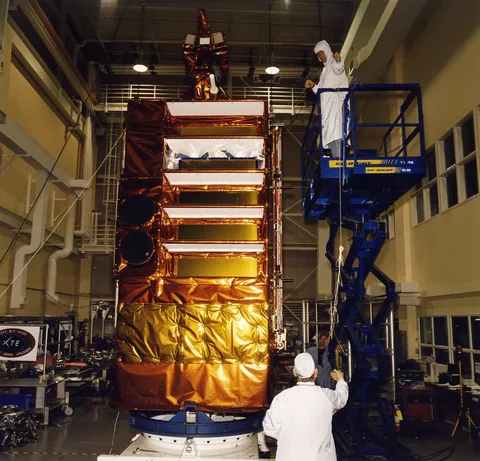
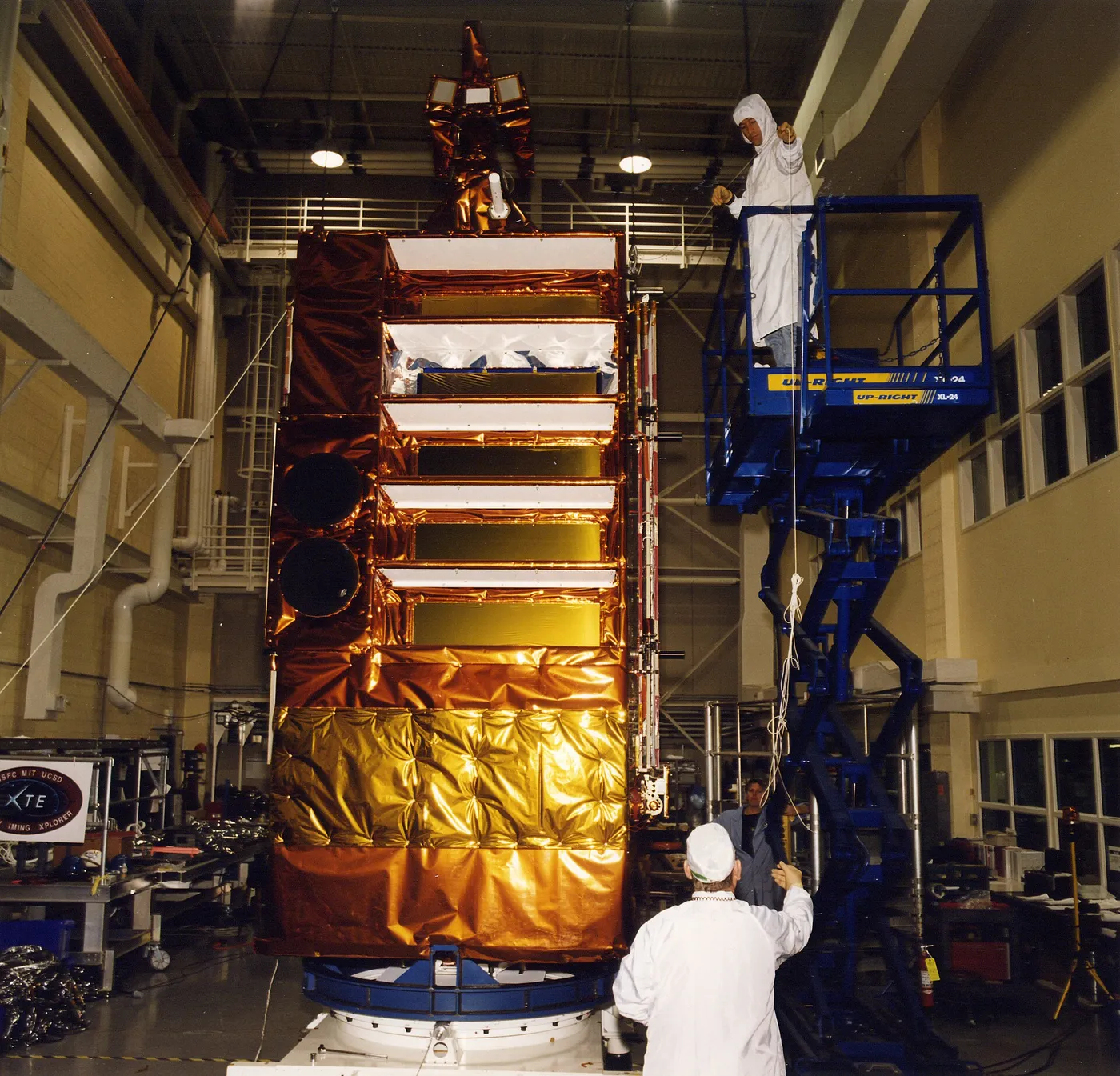

The Rossi X-ray Timing Explorer was built for speed rather than sharpness. It could not resolve fine detail, but it could measure how X-ray brightness varied on timescales down to microseconds — which is what matters when observing matter in the last moments before it disappears into a black hole.
Material spiralling into a compact object orbits at a substantial fraction of the speed of light, and the flickering of its X-ray emission carries information about the orbit that no image could provide. RXTE found quasi-periodic oscillations at frequencies corresponding to orbits just outside the event horizon.
Those measurements provided some of the first observational tests of general relativity in the strong-field regime, where the theory's predictions diverge sharply from Newtonian gravity and had previously been untestable.
It also measured the spin of black holes, discovered accreting millisecond pulsars that had been predicted but never seen, and monitored the whole X-ray sky continuously for outbursts — providing the alerts that let other telescopes catch transient events.
It operated for sixteen years until 2012, and it re-entered in 2018. Its particular capability — very high time resolution over a large collecting area — has not been fully replaced, and its archive is still mined for studies of variability that require exactly that combination.