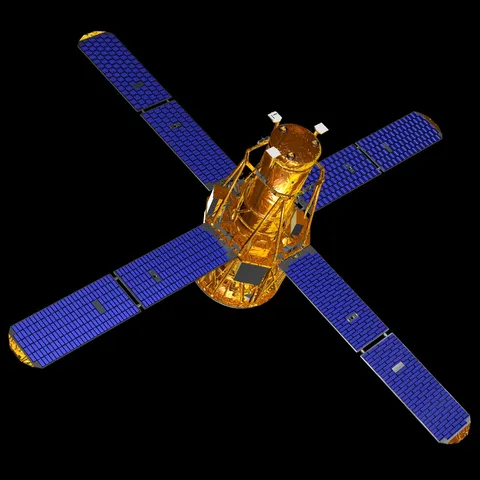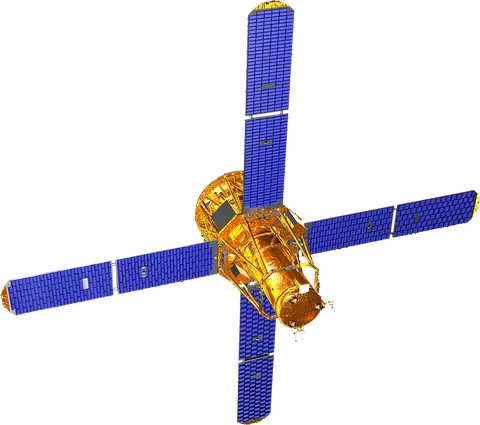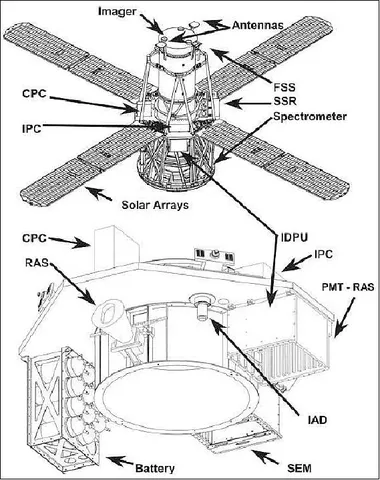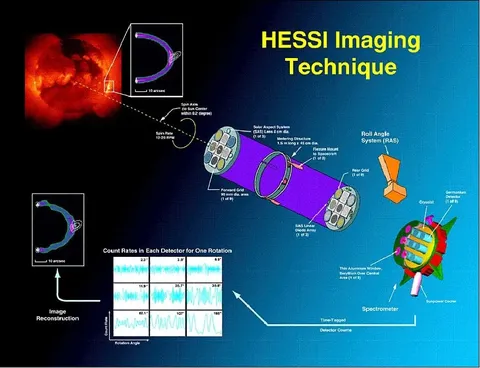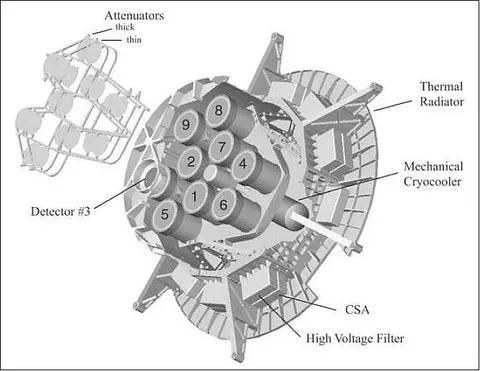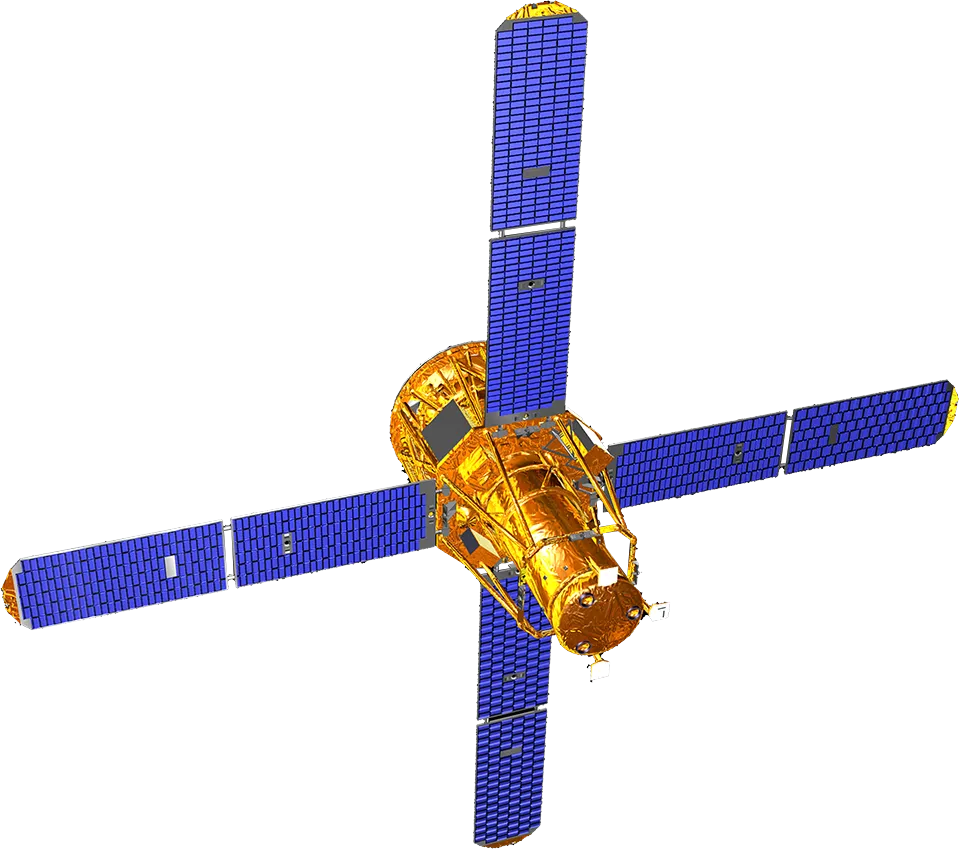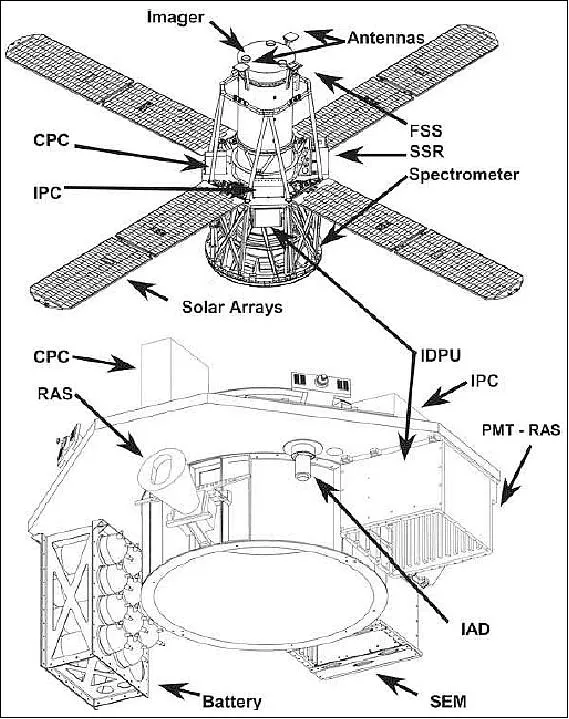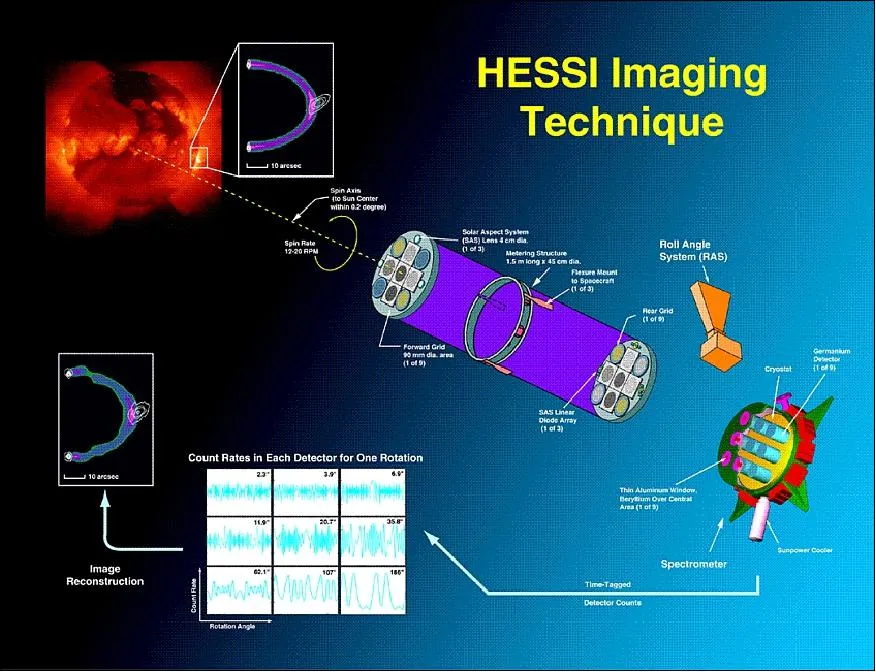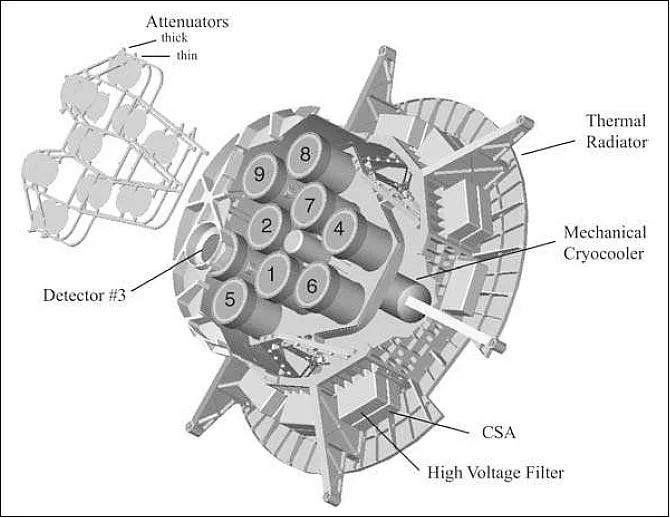
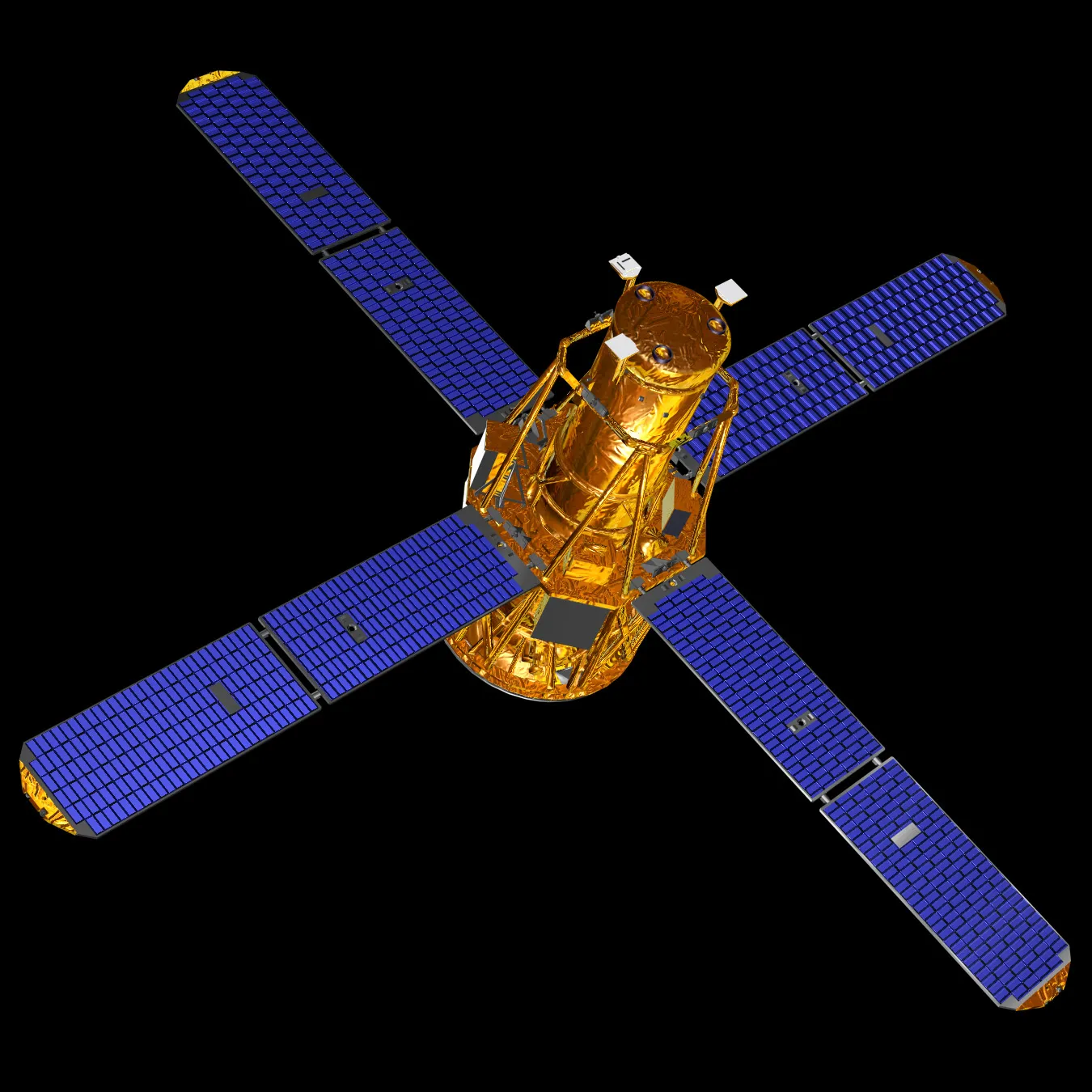

RHESSI imaged solar flares in X-rays and gamma rays without any lens or mirror at all. It spun, and the incoming radiation passed through nine pairs of finely spaced grids that modulated the signal as the spacecraft rotated — from which the image could be reconstructed computationally, a technique borrowed from radio astronomy.
The target was particle acceleration. Solar flares convert magnetic energy into extremely fast electrons and ions with remarkable efficiency, and nobody fully understands how; RHESSI could locate exactly where in a flare the accelerated particles were, by imaging the X-rays they produce on impact.
It found the acceleration happening high in the corona, above the loops that brighten, consistent with magnetic reconnection releasing energy there and beaming particles downward — the geometry Yohkoh had glimpsed and RHESSI confirmed in detail.
It also made an entirely unrelated measurement of some elegance. By observing the Sun's limb precisely as it rotated, it determined the Sun's oblateness — how much its rotation flattens it — to unprecedented accuracy, a number that matters for testing general relativity against Mercury's orbit.
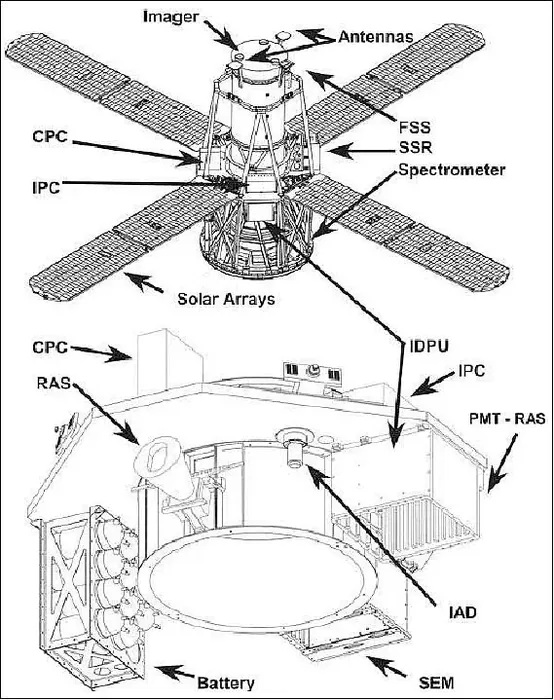
It operated for sixteen years, latterly with several of its nine detectors degraded and its cryocooler struggling, and was decommissioned in 2018. It re-entered in 2023, an event that briefly made the news because a defunct NASA satellite falling is more interesting to editors than sixteen years of solar physics.