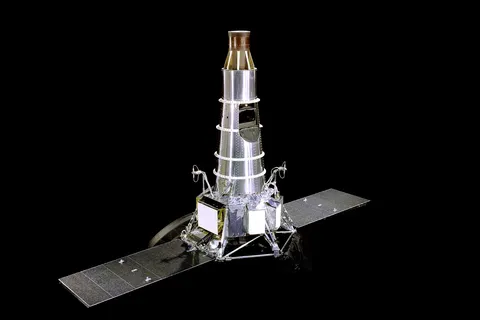
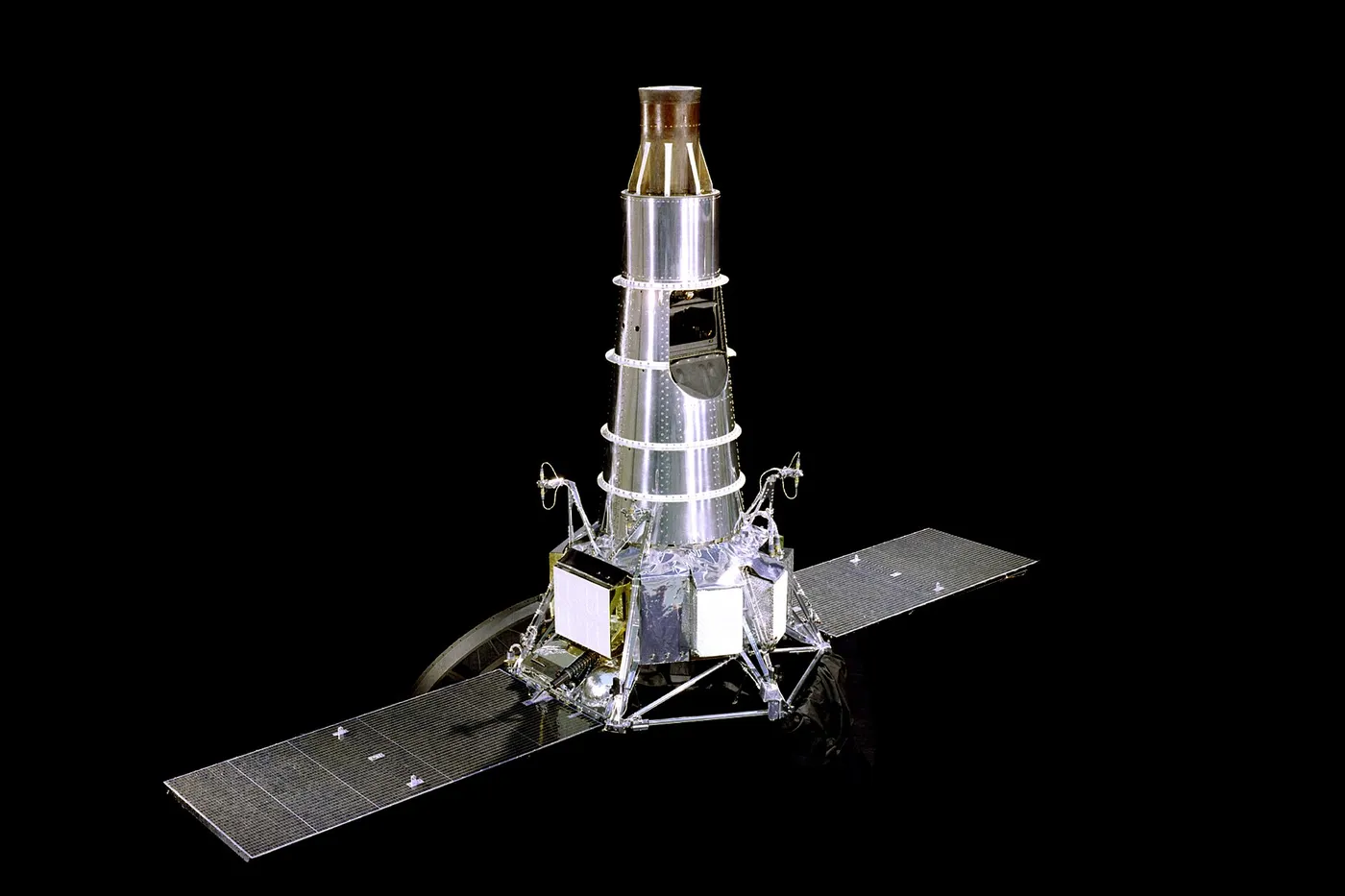

Ranger 9 brought the programme to a close on 21 March 1965, and by now JPL was confident enough to aim not at a safe, smooth plain but at a genuinely intriguing scientific target: the crater Alphonsus, whose floor was marked by dark haloes and winding rilles that some researchers suspected might be traces of recent volcanic activity.
Following the same descent as its successful siblings, the spacecraft returned 5,814 photographs as it plunged toward the surface — the sharpest resolving features only a few centimetres across — before striking the Moon some four kilometres from its aim point. What set this flight apart was its audience. For the first time, pictures from an approaching spacecraft were carried live on television, and viewers at home watched the lunar surface rush up to meet the camera under the caption 'Live from the Moon'.
With that dramatic finale the Ranger series ended: nine spacecraft launched across three and a half years, the first six a harsh schooling in failure and the last three a resounding vindication. Between them the final missions sent home more than 17,000 close-up images that reshaped lunar science and helped smooth the path for the astronauts who would soon follow.
The last Ranger was sent somewhere scientifically interesting rather than operationally useful. Alphonsus crater, with its dark-haloed vents and a central peak, had been the site of a reported gas emission in 1958 and was of far more interest to geologists than to Apollo planners.
Its images went out live. NASA fed the pictures directly to television networks under the caption Live from the Moon, and viewers across the United States watched the surface grow larger in near real time until the signal cut at impact in March 1965 — the first time a planetary encounter had been broadcast as it happened, and a template for the public spectacle that space missions have been ever since.