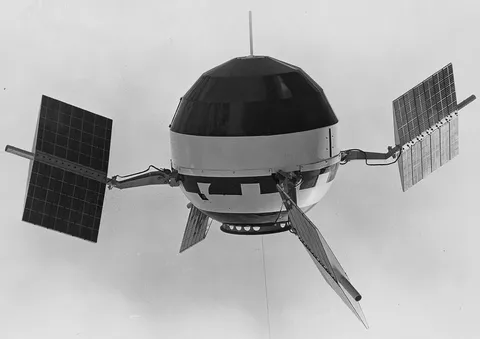
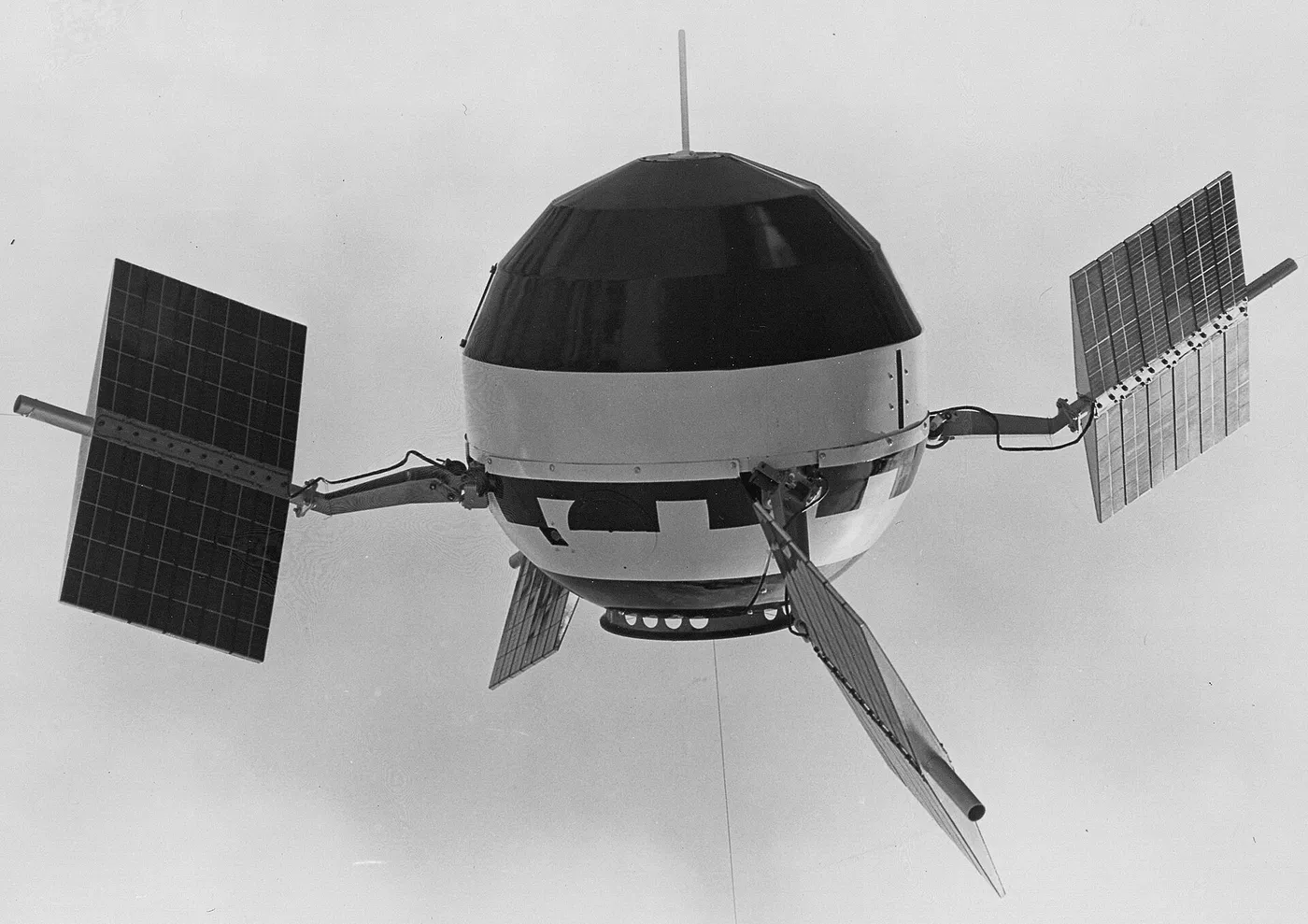

Between the failed lunar Pioneers of 1958 and the deep-space giants of the 1970s came a quieter but genuinely successful mission. Pioneer 5, launched on 11 March 1960, was sent not toward any world but into the empty space between the orbits of Earth and Venus, to find out what conditions were really like in the interplanetary void.
A small sphere studded with solar panels, it settled into an orbit around the Sun and switched on its magnetometer and particle detectors. Over the following months it charted the interplanetary magnetic field and the flow of charged particles streaming from the Sun, becoming the first spacecraft to return real measurements from deep interplanetary space.
Its other feat was one of communication: engineers held it in radio contact out to a distance of some 36 million kilometres, a record for its day, before the signal finally faded that summer. Pioneer 5 proved that a spacecraft could work far from Earth and report home across the solar system — a lesson every later probe would build upon.
Pioneer 5 abandoned the Moon and went into the space between the planets instead, entering solar orbit between Earth and Venus in March 1960 to measure the environment there directly. It was the first spacecraft designed specifically to study interplanetary space rather than to reach a destination.
It stayed in contact to about 36 million kilometres, a record that stood for years, and returned the first sustained measurements of the interplanetary magnetic field and of solar flare particles as they travelled outward. Its data helped confirm that the solar wind is a continuous outflow rather than an occasional event — the same conclusion Mariner 2 would reinforce two years later on the way to Venus.