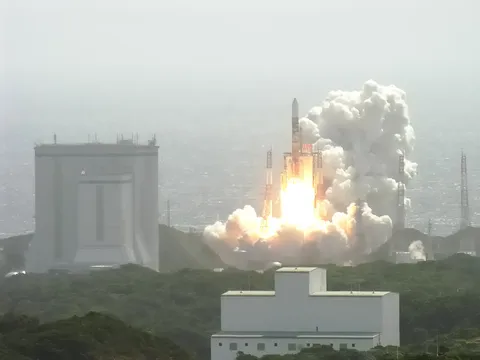
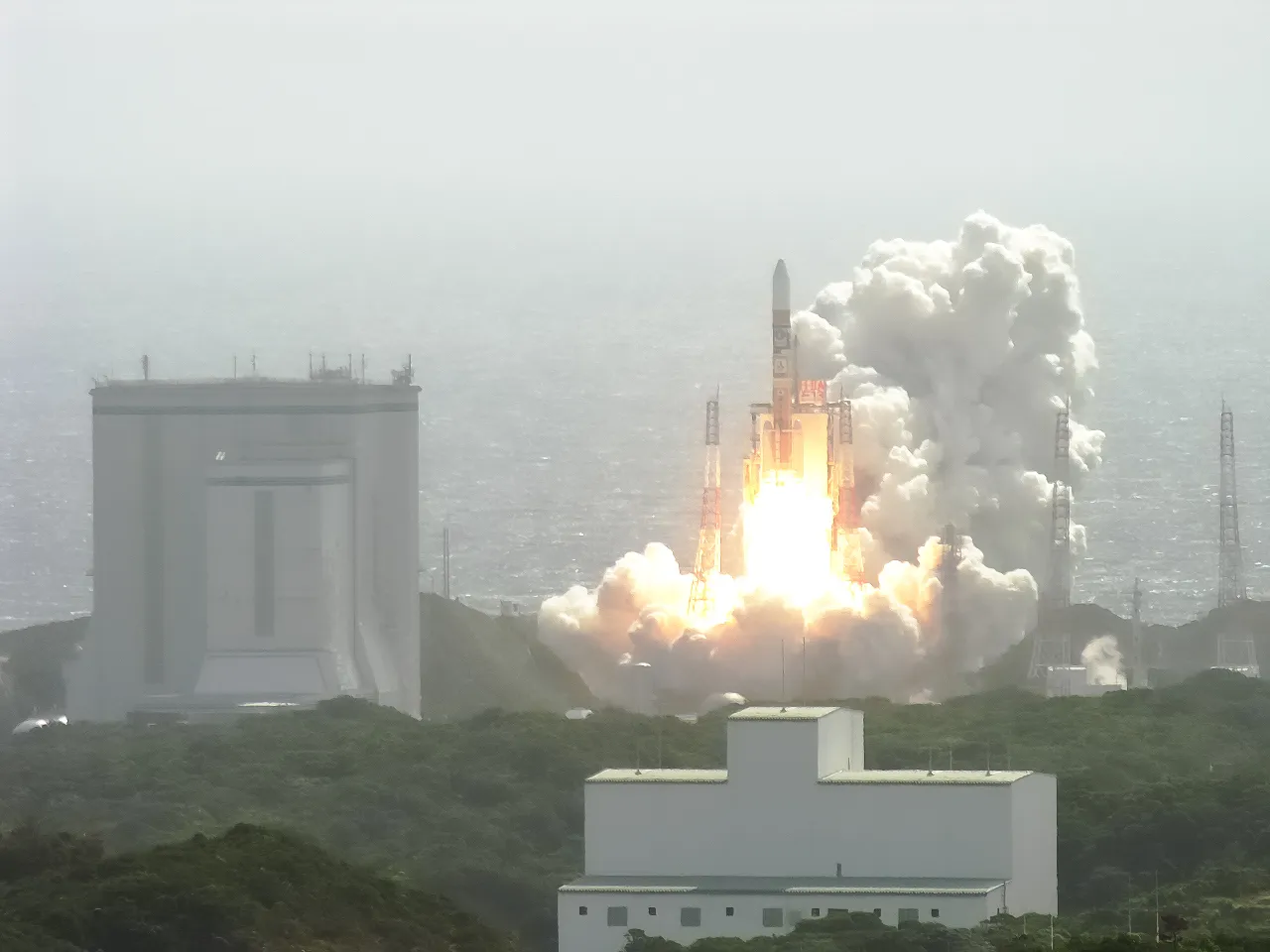

Japan's Kaguya was the largest and most capable lunar mission since Apollo, a three-tonne orbiter accompanied by two small relay and radio-science satellites, named after a princess in a tenth-century Japanese folk tale who returns to the Moon.
It carried a high-definition television camera, and the footage it produced of the Earth rising over the lunar limb — in colour, in motion, in HD — gave a generation their own version of the Apollo 8 photograph. The images were broadcast widely in Japan and did a great deal for public engagement with the mission.
Its laser altimeter and stereo camera produced the first genuinely global topographic map of the Moon, including the far side and the poles, at a resolution far beyond anything previously available. Combined with its gravity measurements — enabled by the relay satellite tracking it over the far side, a first — it revealed the crust to be markedly asymmetric between the two hemispheres.
It also found a hole. Images of the Marius Hills showed a pit some sixty metres across opening into what appears to be an intact lava tube — a natural tunnel beneath the surface. Such tubes are now among the leading candidates for future lunar habitats, offering shielding from radiation, micrometeorites and the extremes of the lunar day.
The mission ended in June 2009 with a controlled impact on the near side, timed so that telescopes on Earth could observe the flash. Its data remains one of the standard reference sets for lunar science, and it marked Japan's arrival as a serious planetary exploration power.