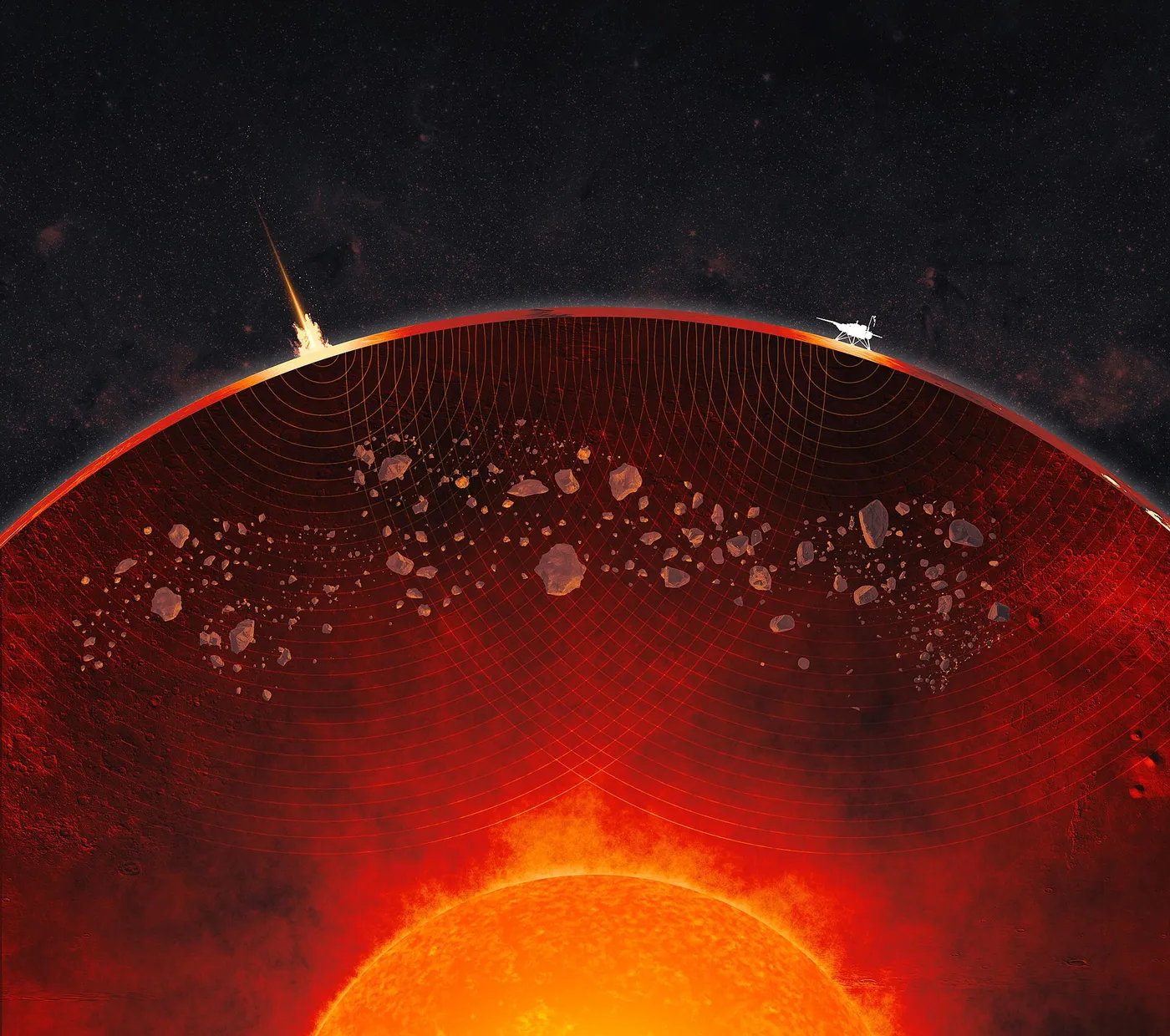

InSight did not move. Where every previous successful Mars lander was either mobile or focused on the surface, this one was a geophysical station designed to sit still in a dull, flat, deliberately boring place and listen to the planet's interior — the first attempt to study the deep structure of another rocky world.
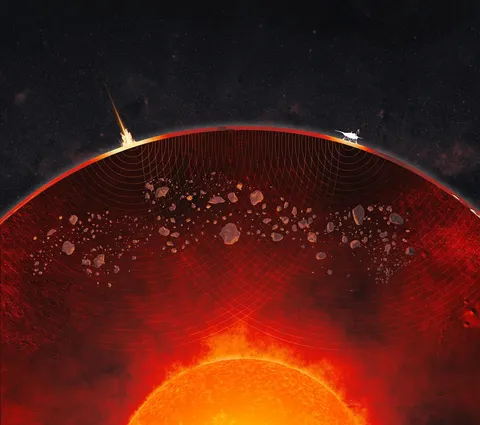
Its seismometer was extraordinarily sensitive, capable of detecting ground motion smaller than the width of a hydrogen atom, and it was placed on the surface by a robotic arm and covered with a wind shield. Over four years it recorded more than 1,300 marsquakes, including several large enough to send seismic waves through the core.

Those waves produced the results. Mars has a liquid core, larger and less dense than models predicted, implying a substantial fraction of lighter elements; its crust is layered and thinner than expected; and its mantle structure is now known in a way that, before this mission, was pure inference. It also caught meteorite impacts, whose seismic and orbital signatures could be matched to fresh craters photographed from above.
Its other main instrument failed. A self-hammering probe nicknamed the mole was meant to bury itself five metres down to measure heat flowing out of the planet, but the soil at the landing site proved to have almost no cohesion and provided nothing to grip against. Two years of increasingly inventive attempts — pressing on it with the arm, filling the hole — failed, and it was abandoned at about 40 centimetres.
Solar-powered on a dusty planet, its end was always going to be gradual. Dust accumulated on the panels through 2022, power fell, instruments were switched off one by one, and the last signal came in December. Its recordings of Martian wind were the first sounds ever captured on another planet.