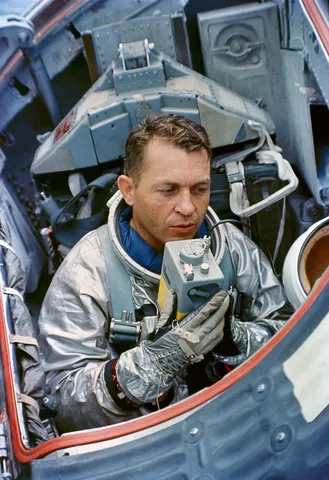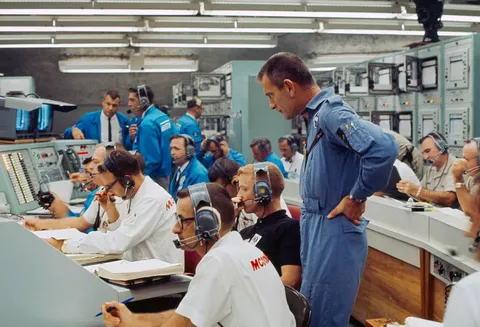
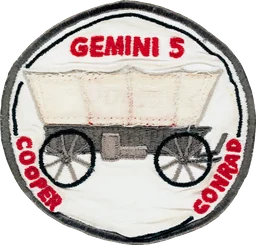
A voyage to the Moon and back would take about eight days, and in the summer of 1965 nobody knew whether a crew could work that long in a cabin the size of a small car's front seats. Gemini 5 existed to find out. Gordon Cooper — the last man to fly Mercury alone — and Pete Conrad launched on 21 August for an endurance run that would more than double the American record.
They flew with a new kind of power. Instead of batteries, Gemini 5 carried fuel cells that made electricity — and drinking water — by combining hydrogen and oxygen, the technology that would later run Apollo. Within hours the oxygen supply pressure began falling and the flight looked as though it might end almost before it began. Powering down to a bare minimum, the crew drifted and waited while engineers on the ground coaxed the system back into life.
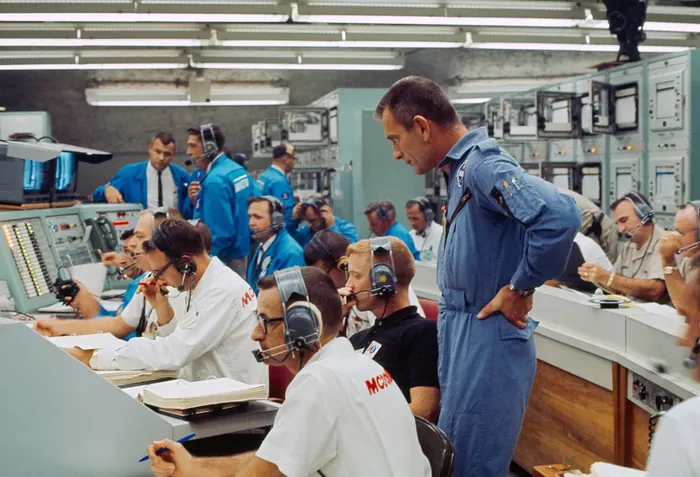
The rescue cost them their headline experiment. A small pod they had released to practise a rendezvous was abandoned when the power failed, so Cooper and Conrad instead flew a “phantom rendezvous,” chasing a point in space calculated by the ground and hitting it with their thrusters. It was rendezvous in everything but the target, and it worked.

What remained was mostly the grind of endurance. The two men could barely move, slept badly, ate reconstituted food, and ran out of tasks as experiments failed; Conrad later described boredom as the mission's real adversary and took to carrying a book on later flights. Their patch had borne a covered wagon and the motto “8 Days or Bust,” until NASA, wary of promising what it might not deliver, made them cover the slogan up.
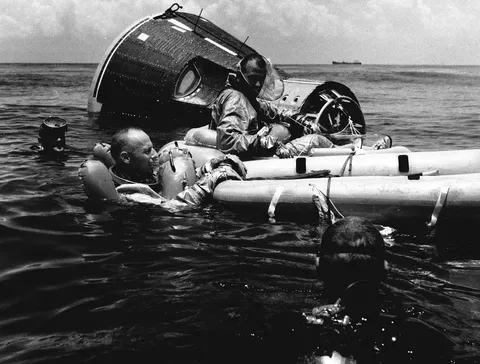
They came home after just under eight days, having proved a crew could survive a lunar-length flight and having taken the endurance record from the Soviet Union. Cooper became the first person to make a second orbital flight; Conrad, irrepressible throughout, would go on to walk on the Moon with Apollo 12 and to command the first crew aboard Skylab.