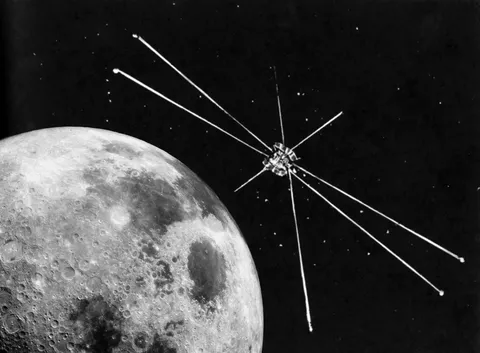
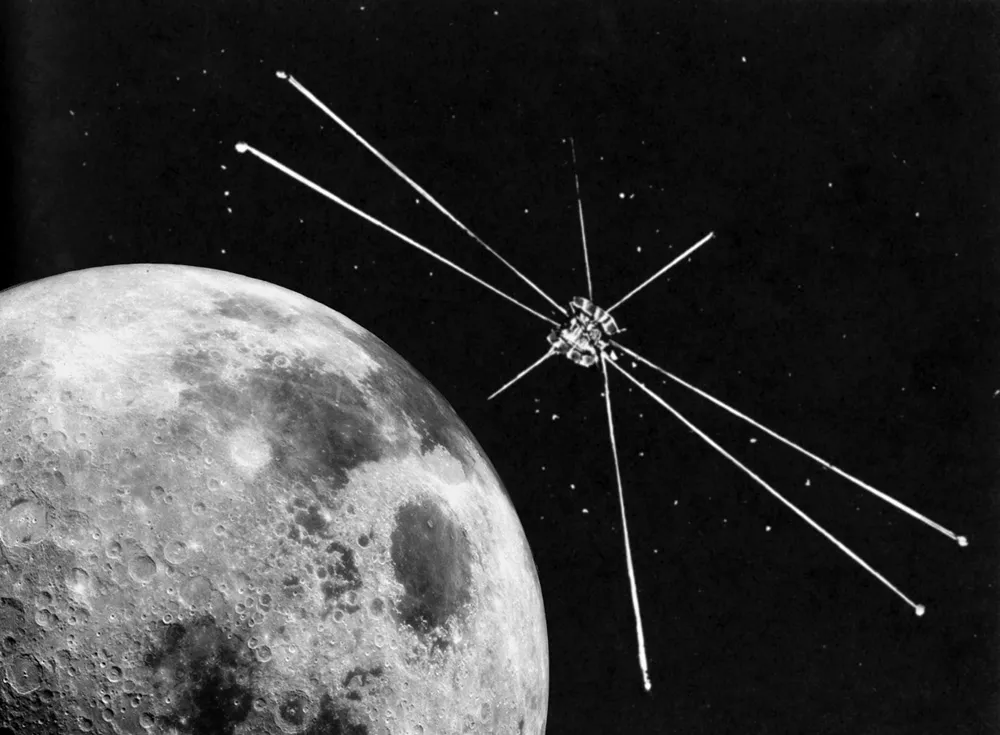

This spacecraft carried the largest structure ever deployed in space at the time: four antenna booms extending 229 metres tip to tip, unfurled from reels like tape measures. It was a radio telescope, and it needed to be that size because it observed at very long wavelengths.
It was placed in lunar orbit for one reason — to use the Moon as a shield. Earth is extraordinarily noisy at low radio frequencies, between natural emissions and human broadcasting, and the only quiet place in the inner solar system is behind the Moon, where the body itself blocks the interference.
From that vantage it mapped the radio sky at frequencies that cannot be observed from the ground at all, because Earth's ionosphere reflects them away. It measured galactic background emission and detected radio bursts from Jupiter and the Sun.
The enormous booms made the spacecraft's dynamics unusually delicate — it was stabilised by gravity gradient, hanging like a dumbbell with the long axis pointing at the Moon, and the flexible antennas oscillated in ways that required careful modelling.
It operated until 1977. The idea it pioneered — that the lunar far side is the best radio-quiet site available to us — has resurfaced repeatedly, and several proposals for far-side radio arrays are under active study, aimed at detecting the faint signal of the universe's dark ages before the first stars formed.