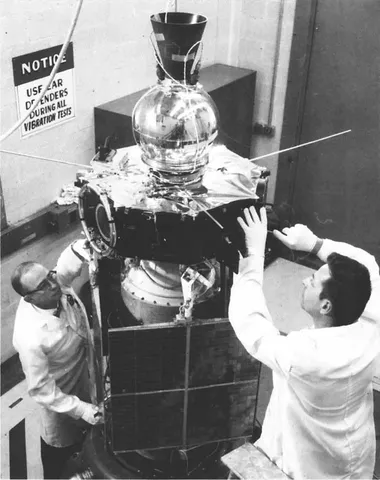
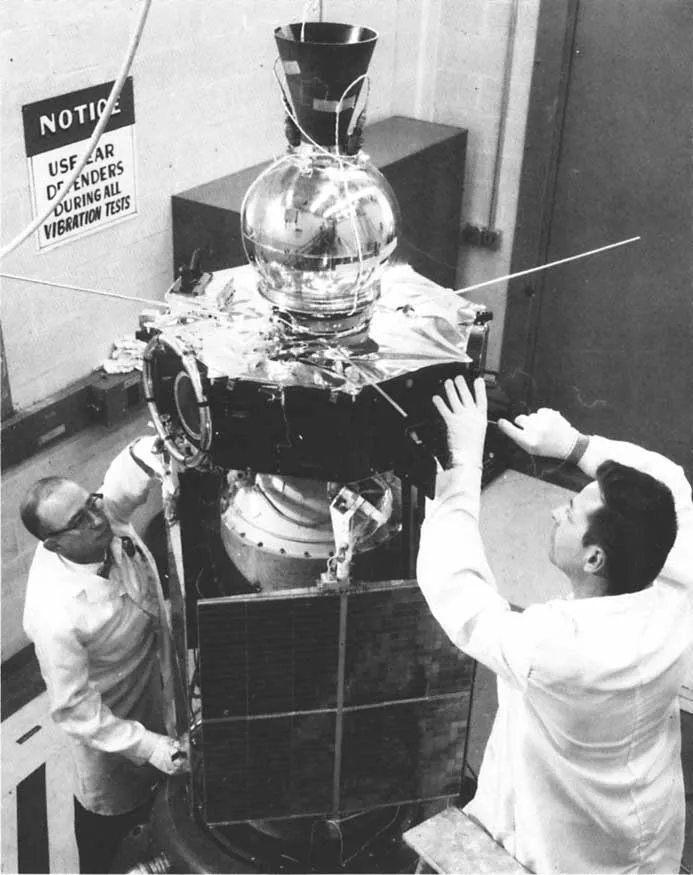

Explorer 35 succeeded where its predecessor had not, entering lunar orbit in July 1967 to study the Moon's interaction with the solar wind. The question was whether the Moon had a magnetic field or an atmosphere that would deflect the wind the way Earth's does.
It found essentially neither. The Moon has no global magnetic field to speak of and no measurable ionosphere, so the solar wind strikes the surface directly and is absorbed — leaving a cavity in the flow downstream, a wake of near-vacuum extending behind the Moon that the spacecraft mapped in detail.
That result mattered for lunar science generally. A body with no magnetic field has no molten conducting core of any size, which constrained theories of the Moon's formation and interior long before seismometers were placed on the surface.
It also measured localised magnetic anomalies in the crust — patches of magnetised rock, remnants of a field the Moon apparently once possessed and lost. Those anomalies are still being studied, and some are associated with the pale swirl markings visible from orbit.
The spacecraft operated for six years before being switched off in 1973. It was part of a family of Interplanetary Monitoring Platforms that collectively established the basic physics of the space environment between the Sun and the planets.