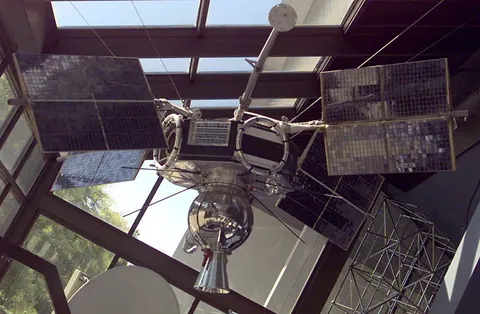
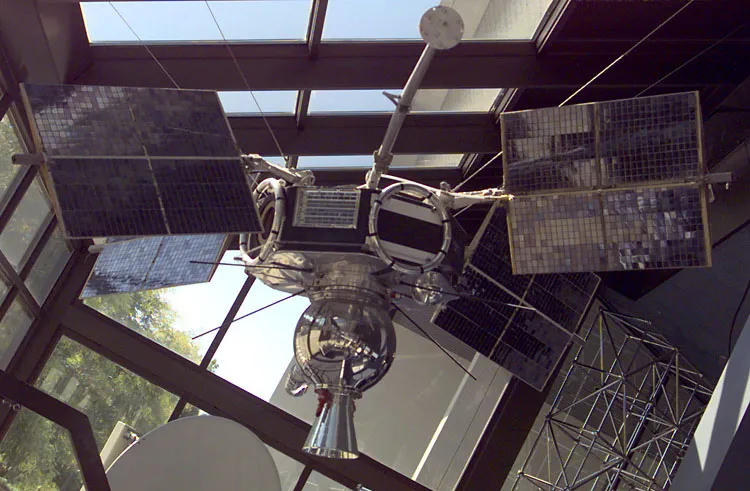

Explorer 33 was meant to orbit the Moon and did not. The launch delivered slightly too much velocity, and mission planners faced a choice: attempt the lunar insertion anyway with a real chance of the spacecraft escaping entirely, or abandon it and settle for a high Earth orbit.
They chose the second, and the spacecraft ended up in an enormous elliptical orbit reaching more than 450,000 kilometres from Earth — beyond the Moon's distance — which turned out to be an excellent place from which to study the magnetosphere.
It spent years sampling the long magnetotail that the solar wind draws out behind the Earth, mapping its structure and the turbulent boundary where the wind meets the planet's magnetic field. Much of the basic geometry of that interaction was established by this spacecraft and its immediate successors.
It also served as a monitor of the undisturbed solar wind, providing the upstream reference measurement against which effects at Earth could be compared — the same function ACE and Wind perform today from the Lagrange point.
The mission operated for more than five years. It is a fair example of a recurring pattern in the early programme: a spacecraft that failed at its stated objective and produced first-rate science anyway, because the instruments were useful wherever they happened to end up.