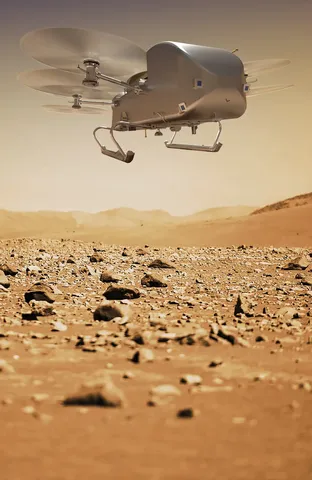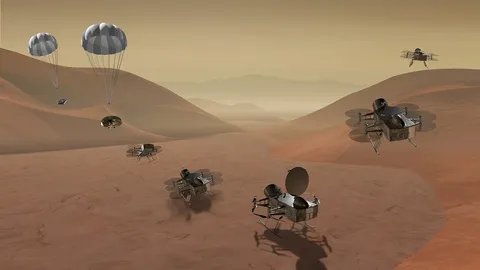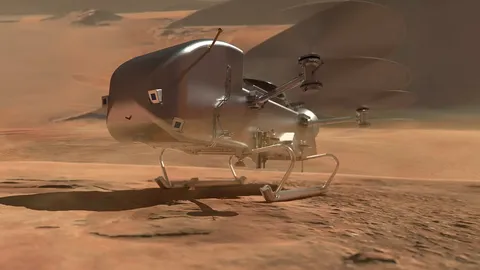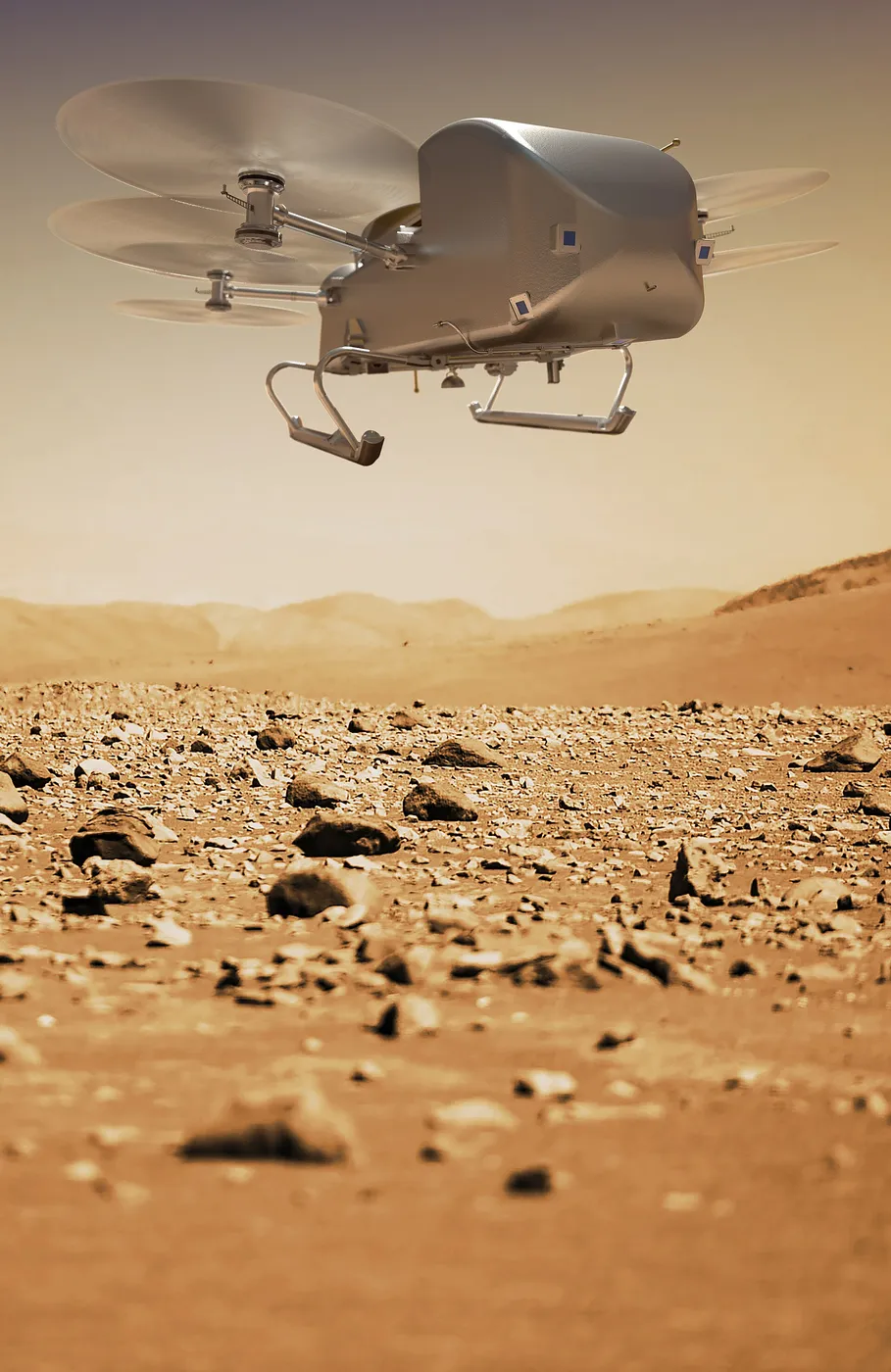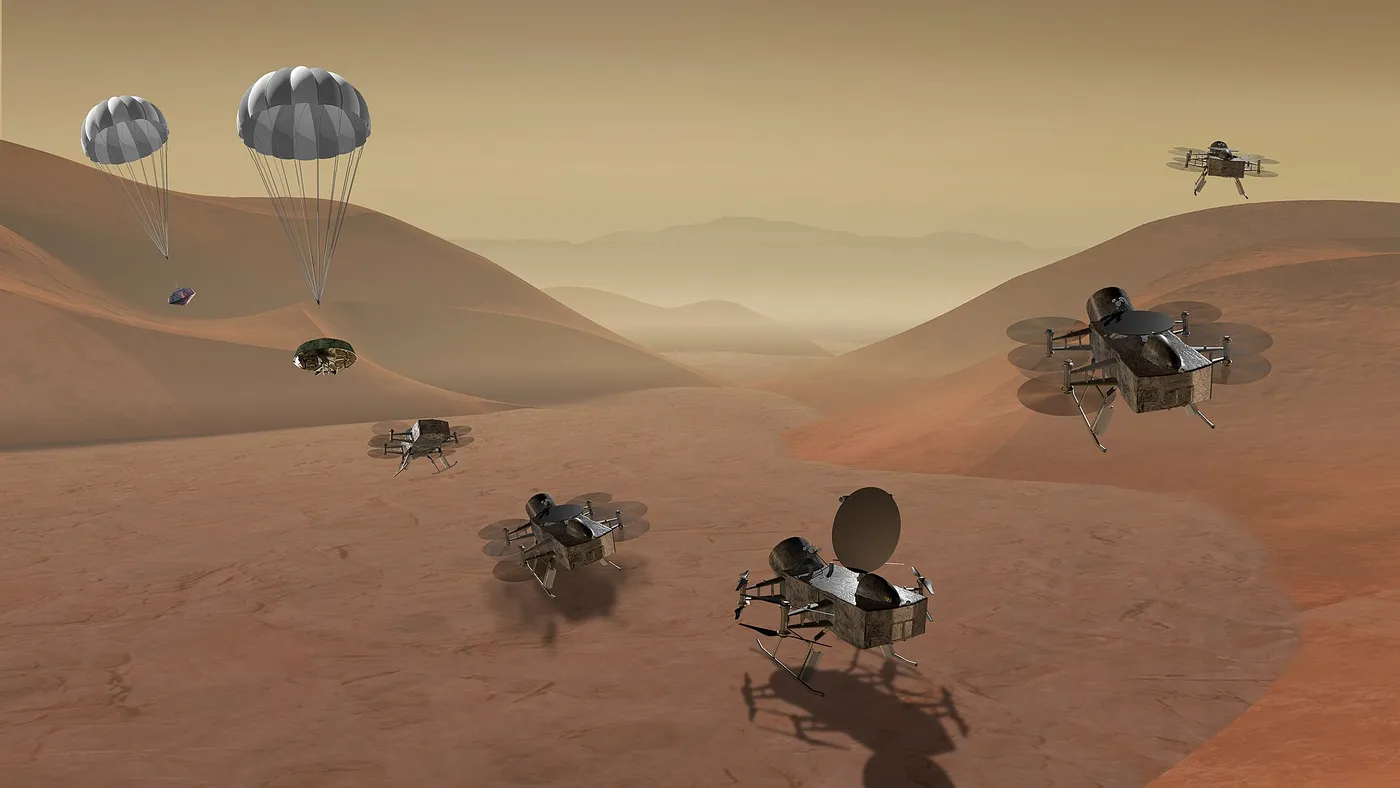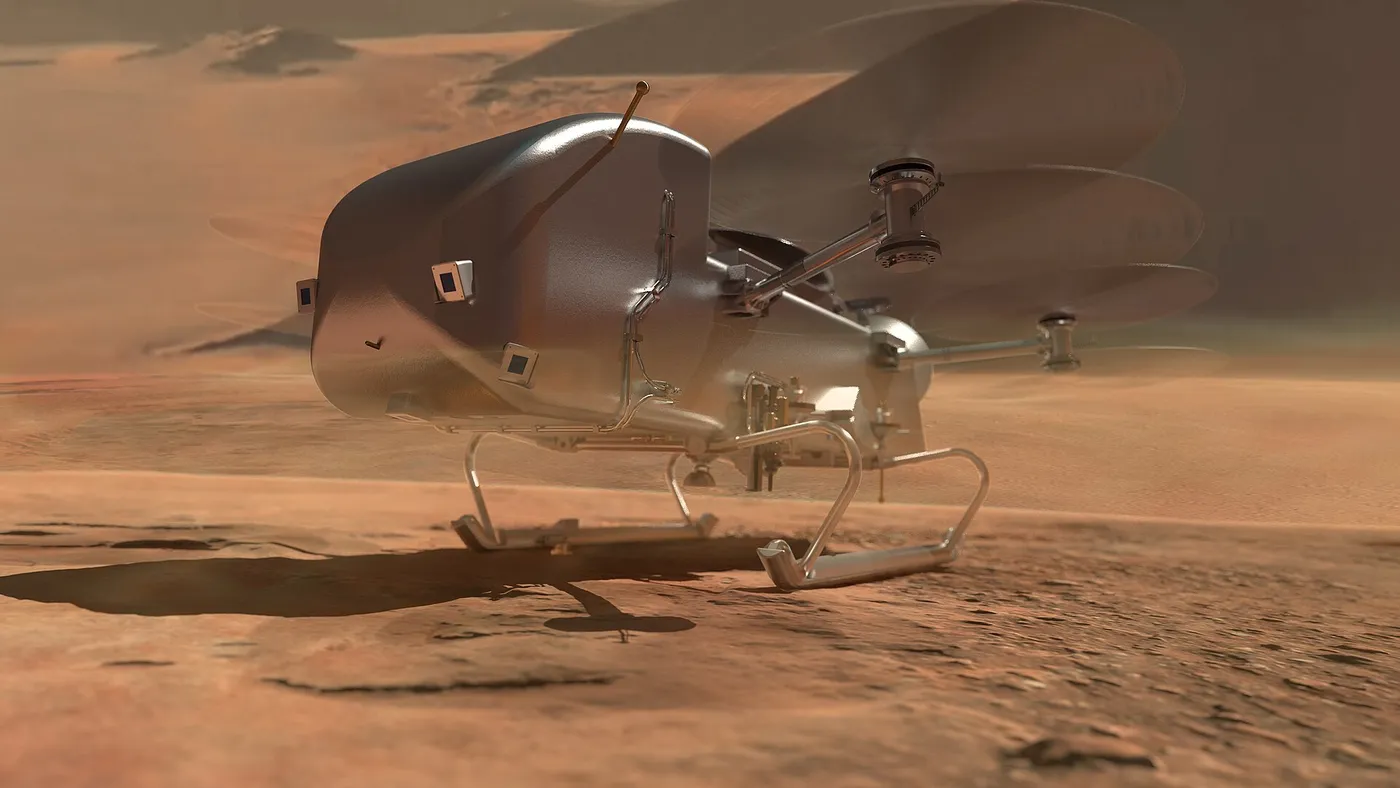


Dragonfly is a nuclear-powered flying laboratory that will hop across Titan. It is a rotorcraft roughly the size of a small car with eight rotors, and it will fly from site to site — tens of kilometres at a time — rather than driving, covering ground no rover could reach in a lifetime.
Titan is the one place in the solar system where this is easy. Its atmosphere is four times denser than Earth's and its gravity is about a seventh, so the power required to fly is roughly thirty times lower than on Earth — a combination that makes an aircraft a more sensible vehicle than wheels on a surface of unknown consistency.
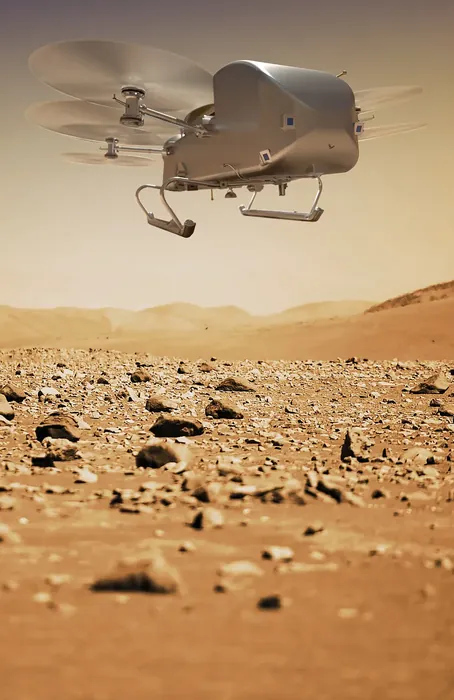
The scientific target is prebiotic chemistry. Titan has liquid methane rain, rivers and seas, a thick nitrogen atmosphere, and complex organic molecules produced continuously in its haze and settling onto dunes of organic sand. It is a laboratory running the chemistry that preceded life on Earth, at minus 180 degrees, without the complication of biology consuming the products.

It will land in the equatorial dune fields near Selk crater, an impact site where liquid water would have persisted for thousands of years mixed with organics — plausibly the most interesting chemistry available anywhere on the moon, and the sort of transient warm-and-wet setting that may matter for origins.
The mission launches in 2028 and arrives in 2034, powered by a plutonium generator because sunlight at Saturn is about one per cent of Earth's and Titan's haze blocks most of what arrives. It is the first mission to fly an aircraft as its primary vehicle on another world, following the proof of concept that Ingenuity provided on Mars.